
How Much Roof Space Do You Actually Need for a Solar System?
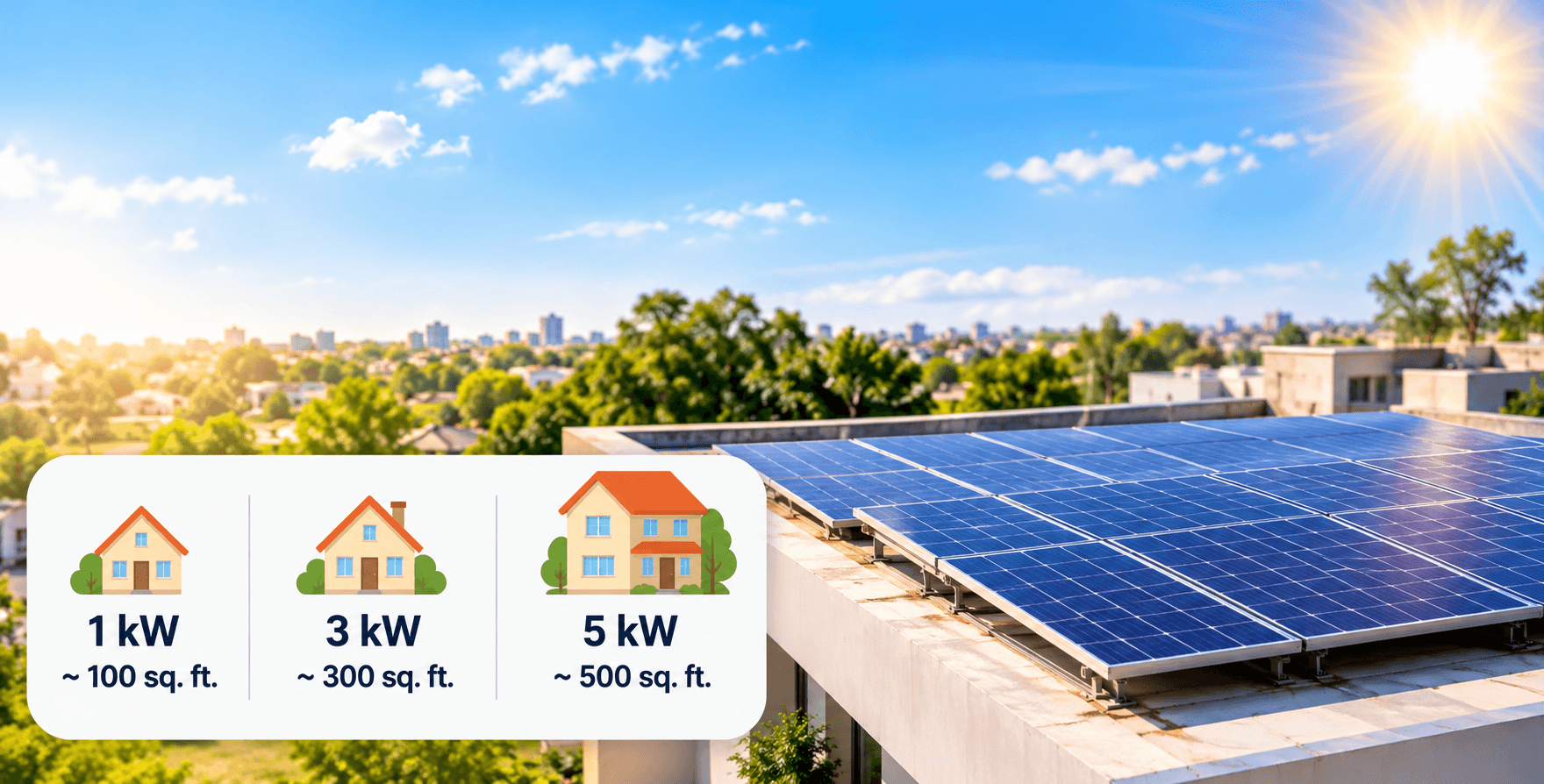
Before any site survey, most homeowners want a rough sense of whether their roof can even fit the system size they're considering. The short answer: as a general rule of thumb, 1 kW of rooftop solar needs about 80–100 square feet of shadow-free area, depending on panel wattage and the mounting structure used.
That estimate changes with panel technology — higher-wattage panels (like the 540W+ modules we typically install) generate more power per panel, so you need fewer panels, and slightly less area, for the same system size compared to older, lower-wattage panels.
Mounting structure matters too. A flush rooftop mount uses the least area since panels sit close to the roof surface, while an elevated carport-style structure (common for flat RCC roofs, since it doubles as a shaded parking or terrace area) needs a bit more clearance between rows to avoid self-shading, slightly increasing the footprint for the same kW.
Shading is the real variable a square-footage rule can't capture — a water tank, a neighboring building, or an overhanging tree can make an otherwise large roof unsuitable for part of its area. This is exactly why we do a physical site survey with shadow analysis before finalizing a system size, rather than quoting off a floor plan alone.
As a quick reference: a typical 3 kW residential system needs roughly 250–300 sq ft, a 5 kW system needs roughly 400–500 sq ft, and a 10 kW system needs roughly 800–1000 sq ft — useful for an initial gut-check, but always confirmed against your actual roof during the survey.
Ready to see what solar could save you?
Try the Solar Calculator